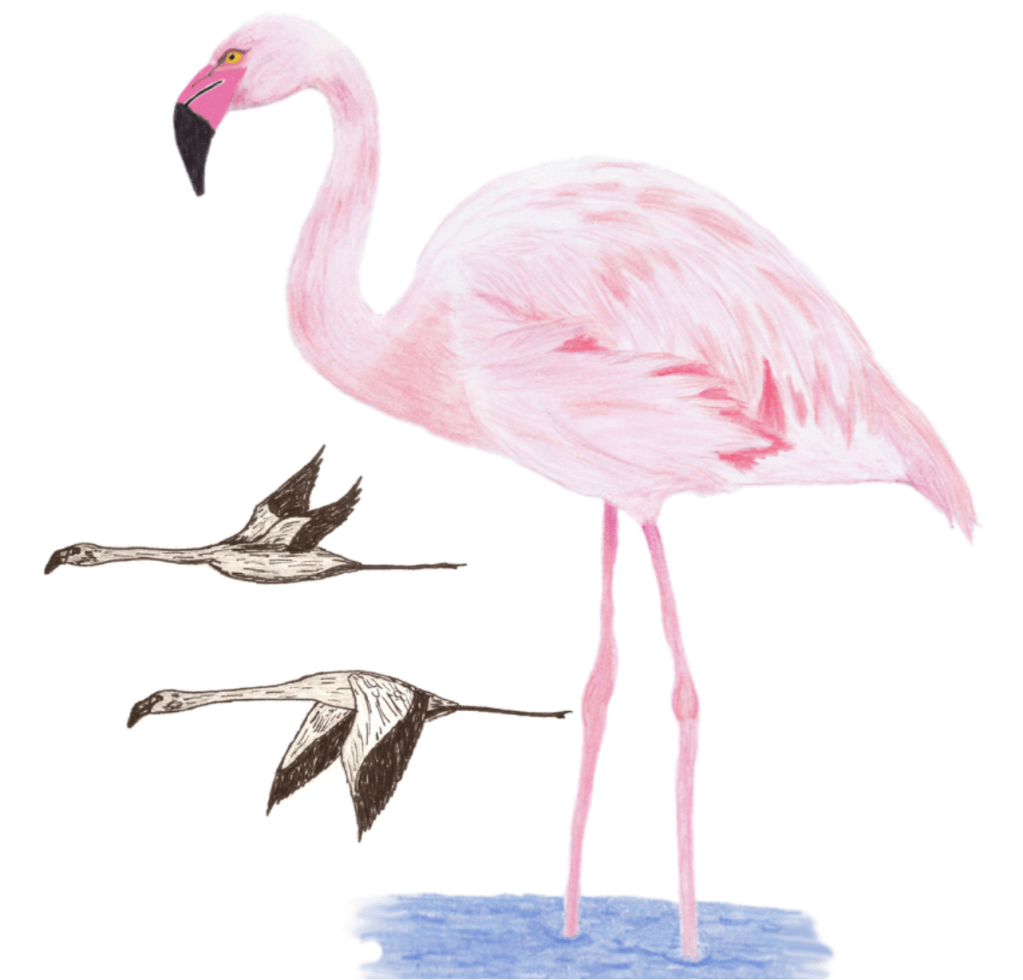
Two flamingo species are found sporadically at suitable waterbodies across Zimbabwe, namely the Greater Flamingo Pheonicopterus roseus (pictured) and Lesser Flamingo Phoeniconaias minor.
Due to the ephemeral nature of their occurrence, I found that these birds were generally unfamiliar to people in most areas, with the exception of those domiciled in drier southwestern areas of Zimbabwe, where flamingo remains are occasionally found under high-voltage power lines which straddle one of their migratory routes to and from the Magadikgadi pans in neighbouring Botswana.
The transitory nature and largely nocturnal movements of flamingos have indeed aroused deep suspicion amongst many local Ndebele and Kalanga people, who associate them with witchcraft, believing that that they purposefully fly high above the clouds in order to avoid detection by the average person. It is also said that lightning is caused as each bird exposes its red underwings to the clouds, and that heavy showers result as they urinate.
An isangoma or isanuse may sometimes collect flamingo feathers and place them on the roof of a home, or near animals owned by the rival of a client in order to attract lightning that will destroy the property. A discovered carcass is thus normally destroyed by fire and reduced to ashes so that the feathers cannot be used for such nefarious purposes, and under no circumstances are these birds eaten.
Local names for flamingos in Zimbabwe:
Sukinyonyo – Kalanga
umDolwa-made – Ndebele
I have been unable to find additional verifiable information on flamingos in folklore from other regions of Africa, apart from a possible Egyptian linkage and correlation with the mythical Phoenix.
Additional Reference:
Cocker, M & Tipling, D. (2013). Birds and People, Jonathan Cape, London, England.
For more information on the two species covered here visit:
http://datazone.birdlife.org/species/factsheet/greater-flamingo-phoenicopterus-roseus
https://ebird.org/species/grefla3/AE-DU
http://datazone.birdlife.org/species/factsheet/lesser-flamingo-phoeniconaias-minor
 Birdlore