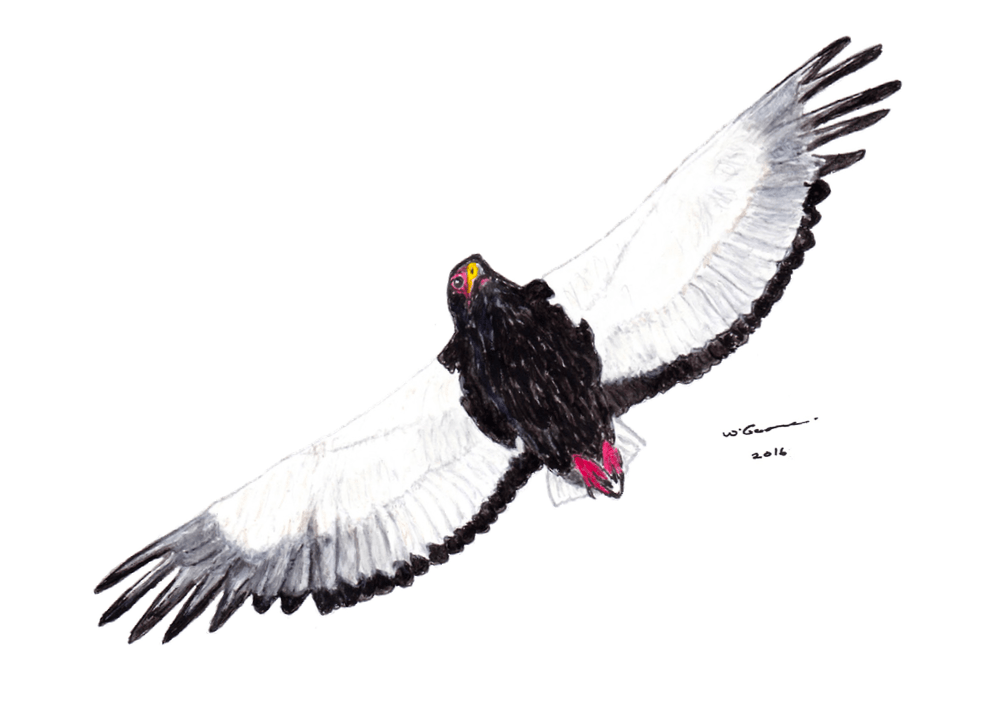
The Bateleur Eagle Terathopius ecaudatus is perhaps the most respected bird in Shona and Ndebele folklore, and is even depicted in San rock art. Shona tribes still revere this eagle as an important totem (known as Chipungu) while its Ndebele name, iNqunqulu is said to be derived from the sound of two fighting birds beating their wings together, or the sound of warriors beating their spears against their shields before going into battle.
Eagles are generally regarded as potent messengers, associated with mediums and the ancestral spirit world, and the Rozvi who once ruled the area around the Great Zimbabwe believed that they were important intermediaries of royalty. Indeed, one legend describes how the severed head of a claimant to the Zwimba chieftainship was flown back to his people in the beak of a Bateleur after he had dared to approach the royal court to state his case.
It is also thought that the Bateleur is depicted in at least one of the seven soapstone carvings discovered at the Great Zimbabwe. Each of these differ significantly and are thought to represent the spirits of former chiefs or kings as some appear to incorporate human lips and toes. These carvings possibly served as a metaphor for the mediating role of royal ancestors between the spirit world below and the god Mwari (also known as Wokomsoro or Nyadenga) particularly in the procurement of rain. Lightning was regarded as the ‘needle that stitches together heaven and earth’, carried in both directions by an invisible eagle ‘Shiri de denga’.
Zezuru women traditionally greeted Chipungu by clapping and trilling while advancing towards a perched bird, and should one of these birds fly over a village a widow would be brought outside in black mourning dress to allow it to look down on her and appease the spirits of the dead.
The nesting area of this species is not generally disturbed and these birds are left to breed in peace by the Shona. As these eagles often nest near rivers, they are considered as important ‘gatekeepers’ and conduits for ancestral spirits that dwell within certain deep pools that serve as a portal to the spirit world below. A Bateleur may only be sacrificed by a n’anga as a last resort in order to alleviate severe drought, and it is believed that a violent flood will ensue after placing the bird in a bag and drowning it in a shallow pool.
As the Bateleur generally flies at a lower altitude than vultures, it is often the first large scavenging bird to locate a carcass, reinforcing the common belief that it is the ‘king of birds’, for whom all other scavenging birds must wait, allowing it to first consume the soft eyes and tongue of the dead animal. Only after the eagle has fed and flown away, may the vultures and other birds descend to feed.
The Ndebele also consider this bird as a powerful mediator and believe that forked lightning is created when two of these birds battle in the sky. The victor, when throwing its opponent earthwards, rips the clouds, causing jagged flashes of light. Historically the ‘nqunqulu’ call predicted the massing of armies, and a gathering of these birds in one location was perceived a certain precursor to war. It was also believed that those over whom the eagle flew would be defeated. The appearance of a Bateleur calling in flight over human habitation was also said to precede great misfortune or simply serve as a symbol of power and strength, while the shadow of a flying bird crossing one’s path was believed to cause certain madness.
These eagles often feed on snakes, which are also regarded as important spirit mediums and considered by many Ndebele to harbour vengeful spirits. Thus, isangomas and isanuse must obtain Bateleur bones and feathers as well as a python’s skin. Both of these animals must be killed unaided and the remains used to adorn their robe and girdle, which is said to render the wearer fearless, while enhancing their healing powers. Feathers may also be wrapped in a cigarette and smoked by a n’anga to strengthen his healing abilities and enhance his powers of prediction.
Local names for the Bateleur Eagle in Zimbabwe:
Chipungu – Shona (all dialects)
iNqunqulu – Ndebele
Pungu – Kalanga/Nambya
Maphukwe – Venda/Sotho
Chimgu, Ximhungu – Shangaan
Chungwe – baTonga
Information for this section was obtained from contributors as well as the following references.
References:
Bozongwana, W. (1983). Ndebele religion and customs (1st ed.). Mambo Press, Gweru, Zimbabwe.
Cooke, CJ. (1964). Animals in Southern Rhodesian rock art. Arnoldia 13: 1-29.
Cooke, P. (1970). Ndebele Bird Names. NADA 10 (2): 67-68.
Huffman, TN. (1981). Snakes and Birds: Expressive space at Great Zimbabwe. Inaugural lecture: University of Witwatersrand, Witwatersrand University Press, Johannesburg, South Africa.
Huffman, TN. (1985). The Soapstone Birds from Great Zimbabwe. African Arts 18 (3): 68-100.
For more information on this species visit:
https://ebird.org/species/batele1?siteLanguage=en_AU
http://datazone.birdlife.org/species/factsheet/bateleur-terathopius-ecaudatus
 Birdlore