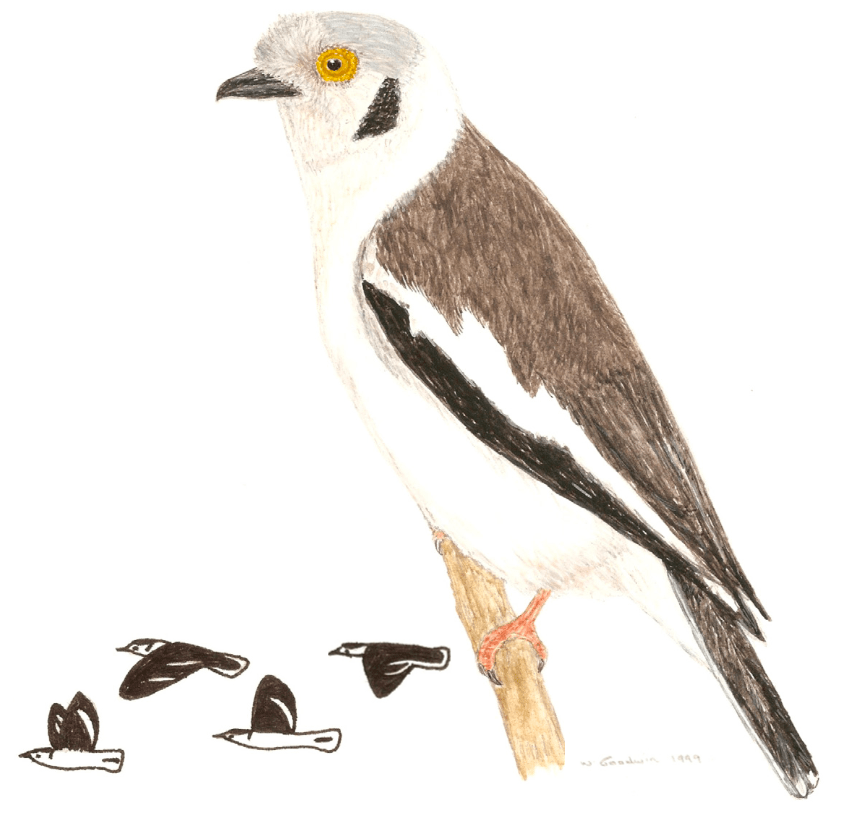
White-crested Helmetshrikes Prionops plumatus are sociable birds, usually frequenting the understorey where they spend much of the day moving from place to place while foraging. Unlike the babblers they are relatively quiet, usually communicating via a low-pitched clicking call. Whilst in flight their prominent black and white wings are a distinguishing feature.
This species appears to be a bird of mixed omens in Zimbabwean folklore. A relatively common belief relayed to me by a number of people of Zezuru and Karanga origin is that a flock flying through, or near to a village is a particularly bad omen, possibly foretelling the death of a close relative. Contrary to this, most other people that I interviewed generally considered this a good and gentle species, representing good luck if encountered. This ‘luck’ would most likely be received in the form of meat, and indeed the various local names can be loosely translated as ‘the bird that follows the hunters’ or ‘the provider of meat’. This belief may be derived from their habit of following various animals in order to hawk insects stirred up by their movement.
Another common Shona belief is that a flock is invariably comprised of seven individuals. As such these birds are often referred to as ‘the seven sisters’ (although one cannot easily differentiate between the sexes and flocks do not always consist of seven individuals). The origins of this belief are a little obscure, however they may somehow be derived from similar folklore related to sociable babbler species in India. In common with the local babbler species mentioned in the previous post, some Ndau, Venda and Sotho people also informed me that if a flock is seen near one’s home, visitors should soon be expected.
Local names for the White-crested Helmetshrike in Zimbabwe:
Chiteveravadzimba, Mashoranyama, Shavishavi, Mariyani – Shona (all dialects)
iHolanyama – Ndebele
iLungwalungwa – Nambya
Masula-bayeni – Venda/Sotho
Mpongo zyathengwe, Dungulungwa – baTonga
Information for this section was obtained only from contributors.
Additional Reference:
Cocker, M & Tipling, D. (2013). Birds and People, Jonathan Cape, London, England.
For more information on this species visit:
 Birdlore