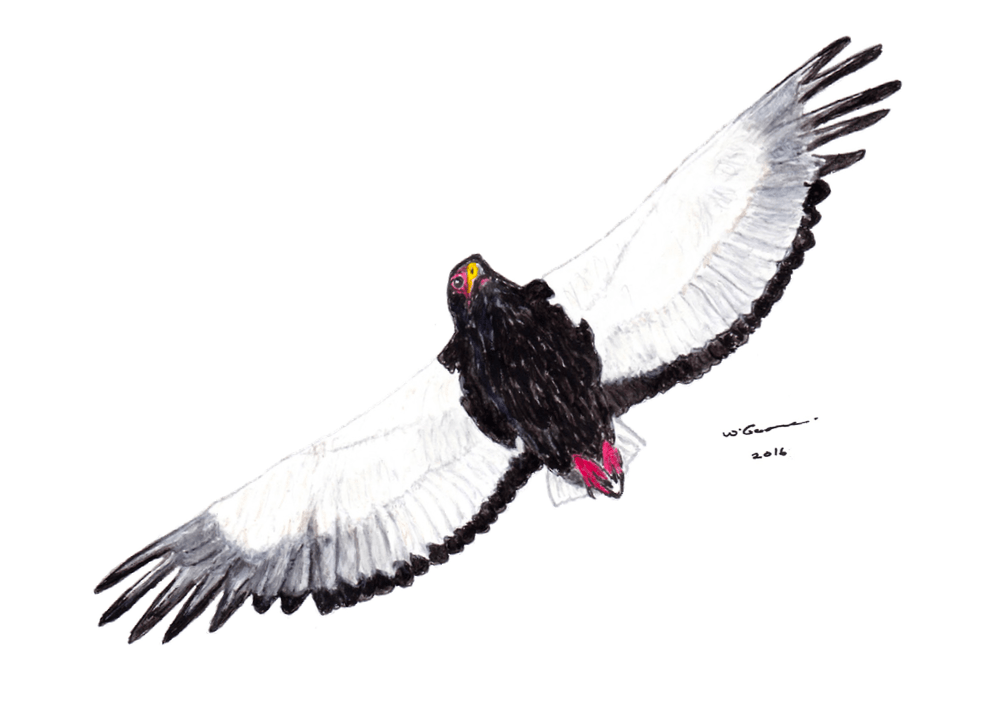
The Bateleur Eagle Terathopius ecaudatus is perhaps the most respected bird in Shona and Ndebele folklore, and is even depicted in San rock art. Shona tribes still revere this eagle as an important totem (known as Chipungu) while its Ndebele name, iNqunqulu is said to be derived from the sound of two fighting birds beating their wings together, or the sound of warriors beating their spears against their shields before going into battle.
Eagles are generally regarded as potent messengers, associated with mediums and the ancestral spirit world, and the Rozvi who once ruled the area around the Great Zimbabwe believed that they were important intermediaries of royalty. Indeed, one legend describes how the severed head of a claimant to the Zwimba chieftainship was flown back to his people in the beak of a Bateleur after he had dared to approach the royal court to state his case.
It is also thought that the Bateleur is depicted in at least one of the seven soapstone carvings discovered at the Great Zimbabwe. Each of these differ significantly and are thought to represent the spirits of former chiefs or kings as some appear to incorporate human lips and toes. These carvings possibly served as a metaphor for the mediating role of royal ancestors between the spirit world below and the god Mwari (also known as Wokomsoro or Nyadenga) particularly in the procurement of rain. Lightning was regarded as the ‘needle that stitches together heaven and earth’, carried in both directions by an invisible eagle ‘Shiri de denga’.
Zezuru women traditionally greeted Chipungu by clapping and trilling while advancing towards a perched bird, and should one of these birds fly over a village a widow would be brought outside in black mourning dress to allow it to look down on her and appease the spirits of the dead.
The nesting area of this species is not generally disturbed and these birds are left to breed in peace by the Shona. As these eagles often nest near rivers, they are considered as important ‘gatekeepers’ and conduits for ancestral spirits that dwell within certain deep pools that serve as a portal to the spirit world below. A Bateleur may only be sacrificed by a n’anga as a last resort in order to alleviate severe drought, and it is believed that a violent flood will ensue after placing the bird in a bag and drowning it in a shallow pool.
As the Bateleur generally flies at a lower altitude than vultures, it is often the first large scavenging bird to locate a carcass, reinforcing the common belief that it is the ‘king of birds’, for whom all other scavenging birds must wait, allowing it to first consume the soft eyes and tongue of the dead animal. Only after the eagle has fed and flown away, may the vultures and other birds descend to feed.
The Ndebele also consider this bird as a powerful mediator and believe that forked lightning is created when two of these birds battle in the sky. The victor, when throwing its opponent earthwards, rips the clouds, causing jagged flashes of light. Historically the ‘nqunqulu’ call predicted the massing of armies, and a gathering of these birds in one location was perceived a certain precursor to war. It was also believed that those over whom the eagle flew would be defeated. The appearance of a Bateleur calling in flight over human habitation was also said to precede great misfortune or simply serve as a symbol of power and strength, while the shadow of a flying bird crossing one’s path was believed to cause certain madness.
These eagles often feed on snakes, which are also regarded as important spirit mediums and considered by many Ndebele to harbour vengeful spirits. Thus, isangomas and isanuse must obtain Bateleur bones and feathers as well as a python’s skin. Both of these animals must be killed unaided and the remains used to adorn their robe and girdle, which is said to render the wearer fearless, while enhancing their healing powers. Feathers may also be wrapped in a cigarette and smoked by a n’anga to strengthen his healing abilities and enhance his powers of prediction.
Information for this section was obtained from contributors as well as the following references.
References:
Bozongwana, W. (1983). Ndebele religion and customs (1st ed.). Mambo Press, Gweru, Zimbabwe.
Cooke, CJ. (1964). Animals in Southern Rhodesian rock art. Arnoldia 13: 1-29.
Cooke, P. (1970). Ndebele Bird Names. NADA 10 (2): 67-68.
Huffman, TN. (1981). Snakes and Birds: Expressive space at Great Zimbabwe. Inaugural lecture: University of Witwatersrand, Witwatersrand University Press, Johannesburg, South Africa.
Huffman, TN. (1985). The Soapstone Birds from Great Zimbabwe. African Arts 18 (3): 68-100.
Due to its unusual habits and relatively strange appearance, the stork-like Hamerkop (Scopus umbretta) has become the subject of many taboos, making it one of the more eminent species, a fact which has almost certainly contributed to the ongoing protection of this species in the rural areas of Zimbabwe.
Hamerkops frequent suitable freshwater habitats, with a preference for quiet sections of rivers and streams where they often remain motionless for long periods, resting or scanning the water for frogs, tadpoles, and other aquatic prey, a habit which has led to the prominent common local belief that they are ‘vain’ birds that need only one eye with which to admire their own reflection.
These birds construct a particularly large stick and reed nest, normally situated in the fork of a tree or atop a boulder, often on a secluded riverbank. Construction may take many months and nests often contain unusual ‘bits and pieces’ such as bicycle tyres, plastic toys, string, rags, wire, building hardware, piping, tin foil, shoes and clothing, as well as bones and large feathers, all incorporated into the fabric. This habit of collecting various personal and household items is likened to the practice of a sorcerer gathering such items in order to cast a controlling spell, or for other nefarious purposes. This fact has not escaped the attention of local people, and during discussions I discovered that these items are indeed much sought after by traditional practitioners who may sometimes even destroy the nest to retrieve them. The hollow structure includes a single nesting chamber with only one downward facing entrance and are plastered internally with mud. However, despite this, it is commonly believed that these birds actually construct two chambers, with the additional one serving as a storehouse for bones, while multiple entrances enable a rapid escape, making the birds particularly difficult to catch. A person who is adept at evading others is thus likened to the Hamerkop.
I also recorded the Zezuru belief that, should a person place nesting material on the roof of a hut, a Hamerkop will soon discover it and proceed to strip the thatch. A person who collects and hoards ‘junk’ is likened to these birds. Another belief is that the act of nest disturbance may lead to madness and cause an ordinary person to become disoriented, following the bird on its wanderings. Anyone guilty of killing one of these birds would suffer a similar fate. In addition, the fact that other animals associated with the occult, such as snakes, may inhabit abandoned nests seems to have reinforced the belief that bad luck will befall anyone who dares interfere with the nest or birds.
As Hamerkops form a socially monogamous pair, the bones are sometimes used by Shona n’angas to form a potion to encourage fidelity in the husband of a female client, while Nambya people interviewed related that that a concoction made from this bird’s eggs will enable the recipient to become invisible.
Another common belief is that should one of these birds fly across your path, any travel plans for the day should be abandoned. However should one fly parallel to the intended route, this would indicate a safe journey ahead. A Hamerkop in flight over a homestead is said to signify a particularly bad omen, especially when calling, perhaps heralding the death of a close relative.
I found it surprising that despite the continued prominence of this unusual bird in contemporary folklore only one depiction of this bird is known in local San rock-art.
Broadly similar beliefs are shared throughout much of southern and Africa, with some slight variation within the basic common themes already mentioned. However, it appears that this trend is less uniform across the rest of the continent. With additional reference to the book Birds and People, I have attempted below to summarise some of these variations, along with other information that I did not encounter during Zimbabwean interviews.
A saying of the Lungu people of south-west Tanzania is that this species ‘builds a house but does not sleep in it’. This is in possible reference to their propensity for nest abandonment, even after a lengthy nest-building period. It is believed that the nest must pass a ‘test’ which involves a successful ‘first pass’ entrance at high speed. Upon failure, the nest is abandoned and another attempt must be made elsewhere.
Other prevalent beliefs from the Eastern Cape (South Africa) relate to the Hamerkop’s perceived role in heralding rainfall, possibly associated with active nest building in the period leading up to breeding in the rainy season. Indeed, in this same area a bird was found sacrificially killed and hung upside-down in a tree in order to appease the spirits for the procurement of rain during a period of drought. An association with lightning is also made both in the Eastern Cape and in northern Botswana, where the disturbance of a nest or bird would result in lightning strike on the perpetrator’s dwelling, directed by the calling or mere presence of one of these birds. It is interesting that I noted a broadly similar mixture of beliefs regarding either rainfall or lightning when dealing with other important species such as the Ground Hornbill, Bateleur Eagle, storks, and flamingos, which will be covered in future posts.
In some areas of Zambia, there appears to be little regard for this species, while the Mbeere of Kenya regard these birds as foolish and lazy and do not eat them simply due to their ‘unclean’ diet of frogs and tadpoles. However, at least amongst some of the neighbouring Kikuyu, these birds are still believed to be linked to sourcery.
Additional Reference:
Cocker, M & Tipling, D. (2013). Birds and People, Jonathan Cape, London, England.
The life history of birds has become interwoven with traditional beliefs and folklore, and across southern Africa they are widely regarded as mediators and emissaries that provide an important link between the interdependent natural and supernatural worlds. Due to this spiritual significance many birds (and other animals) were historically protected according to traditional belief systems.
In common with many other peoples across Africa and other continents, local tribes and clans traditionally adhered to a totem system, according to which, certain creatures associated with ancestral spirits were adopted as namesakes and afforded special status. Use of these animals was largely restricted to traditional practitioners, who collected species of significance for spiritually related purposes. In this way use remained sustainable, however in modern times many of these practices appear to have broken down. A number of species now face incipient pressure due to a combination of unsustainable anthropogenic threats, including increased harvesting and illegal trade to satisfy markets both locally and abroad.
Traditional beliefs and folklore belong to the collective, and are generally passed down to future generations by word of mouth, with relatively few written resources available. As these beliefs once widely promoted a wider respect for the natural world, it is important that they are captured for both their inherent and instrumental value. Indeed, as part of the mandate for the nascent United Nations Decade on Ecosystem Restoration, proponents should seek to build a complimentary global values-based movement, where societal decisions regarding valuable ecosystems are not based solely on scientific and economic grounds, but on one that also recognises the value of traditional knowledge bases.
For more information on the United Nations Decade on Ecosystem Restoration visit:
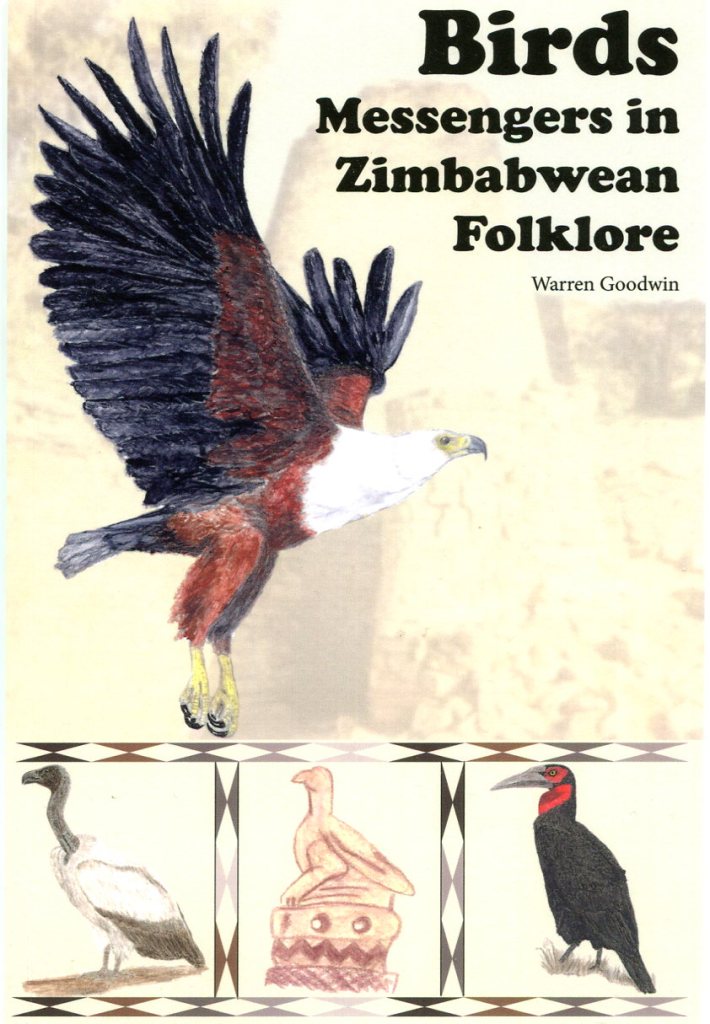
The information on which this blog will be based was originally collected for a book entitled Birds – Messengers in Zimbabwean Folklore that brought together local beliefs on birds that most commonly feature in the Zimbabwean context. Although the few available written resources were consulted, content was mostly obtained from original material collected during personal interviews with thirty-one individuals over a three-year period (1996 to 1999) using Roberts’ Birds of South Africa as a standard identification reference.
Discussions were ad hoc, and carried out with free, prior and informed consent at various locations, with some conducted in remote villages. These often became ‘family affairs’ attended by both elders as well as the younger generation who joined in to listen. Only material that could be verified by at least two additional (independent) sources was included in the book and there remain a number of taxa that warrant further follow-up as additional information is now available.
It is my hope that this blog will stimulate further interest and help to expand on the current body of knowledge surrounding this subject. Although based on birds in the Zimbabwean context, where possible, I will expand the discussion to include other African countries, as many broadly similar beliefs are shared across the continent, and indeed further afield. Different bird taxa or related groups will be dealt with via each successive post, following the traditional order found in most popular bird guides. In order to provide some context, I will begin with a brief introduction to the tribes of Zimbabwe.
San
The San were the first known people to inhabit southern Africa. Being primarily nomadic hunter-gatherers, some made use of caves and rock overhangs for shelter where they depicted their interpretations of many animals, including birds, possibly affirming their deep connection to the natural world. With the arrival of more dominant tribes and the subsequent spread of agriculture the San largely withdrew to less habitable areas within the region.
Shona tribes
The forebears of the Shona tribes originally moved into the region from the north, and by the late Iron Age the mining and forging of iron had become an important factor in their way of life. More permanent homes were constructed of wooden poles and clay (dagga) and families began to live together in villages under a headman or chief. Trade also began to develop between local people as well as outsiders such as the Portuguese.
Later, larger stone settlements known as madzimbabwe were located strategically within the region, the largest of these being the Great Zimbabwe. The economy revolved mainly around cattle, and leaders controlled their herds from these settlements. Grain was grown mainly for beer-making and maize meal, while trade in gold, ivory and ostrich products flourished.
The Shona developed a complex traditional religious system, worshipping the god Mwari through various spiritual mediums. Many religious shrines were respected and a totem system adopted whereby an animal or bird was recognised and protected as a tribe’s medium. The names Shiri and Chipungu are two such examples of Shona bird totems. The Great Zimbabwe served as the residence of possibly the most powerful ruler in the south- eastern part of Africa, however his state began to decline and other tribes and states such as the Rozvi, Mutapa and Torwa began to develop as offshoots.
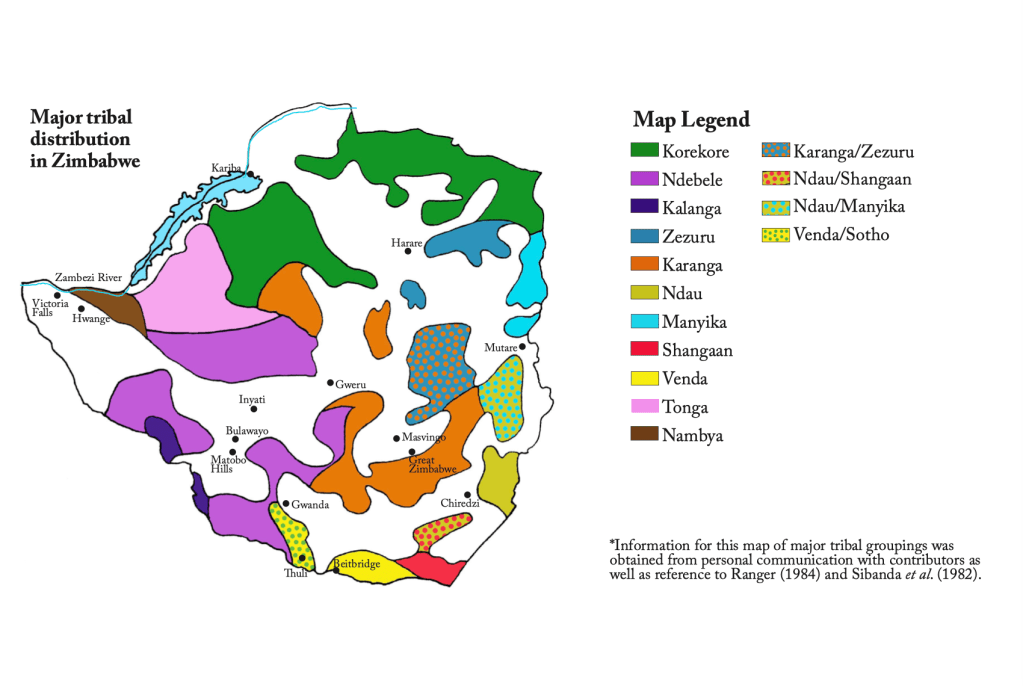
Five main Shona orientated tribes currently reside in Zimbabwe, namely the Korekore, Zezuru, Manyika, Karanga and Ndau.
The Karanga consist of 15 sub-groupings and reside in many areas formerly domiciled by other tribes, however their main home area includes the midlands and extends into the southern and southeastern lowveld. The traditional home areas of the Korekore and Zezuru are located in the northern and central areas of Zimbabwe and collectively represent a large proportion of the local population. Although the Manyika and Ndau are closely allied to their Mozambican neighbours to the east, they share many common beliefs and customs with other Shona tribes.
Ndebele (Matabele)
The Ndebele nation originates from the area now known as KwaZulu-Natal on the eastern coast of South Africa. During the reign of the Zulu king Shaka in the early 1800’s a number of Nguni people fled the internal strife within the region and dispersed to settle in more peaceful areas. This forced migration was known as Mfecane.
One of the chiefs who fled during this period was Mzilikazi, who led up to five hundred of his followers across the Drakensberg Mountains to seek a stronghold the northern part of South Africa. During this period a number of individuals from other ethnic groups such as the Sotho and Tswana were subjugated and assimilated into the Ndebele tribe. It was at this time that this group became known as the Matabele or ‘men of the long shields’.
Around 1838, Mzilikazi was forced to vacate his village Mosega by the Afrikaner militia and from here he moved his tribe even further north into Botswana. After only one season the Matabele again moved north into what is now Zimbabwe. Armed groups (impi’s) were sent to the northeastern plateau in order to overpower the Rozvi while others headed towards the Zambezi River. During this time Mzilikazi left behind an impi led by a chief (induna) named Gambo to guard the western flanks.
The first capital was established at Inyathi, while the Matobo hills remained an important area and home to many sacred shrines, such as Njelele, which had featured strongly in the tradition of the local Shona tribes who worshipped Ngwali – the spirit of the Matopos.
The Matabele nation was divided into three castes with differing social status. Those of the highest status were the abeZansi from the original Zulu (Khumalo) clan. The second group, the abeNhla was made up mainly of Sotho and Tswana peoples who had been assimilated earlier, while those of the lowest status were the tribes that had most recently been subjugated. This group known as the amaHole, was comprised chiefly of Shona orientated groups. As these people comprised a large percentage of the new social order, it was inevitable that many of their traditional beliefs intermingled with those of the Matabele.
Shangaan
The Shangaan are descended from a separate offshoot of the Nguni, who migrated from Zululand in the early 1800’s. This group, the Gaza, subjugated some Swazi people and other clans on their journey northwards, before settling and gaining control over most of southern Mozambique and southeastern Zimbabwe. Local Shona tribes such as the Ndau respected and paid taxes to the court of the chief Shoshangane. This subjugation continued until 1889 when internal strife resulted in an eventual migration to the east and a breakdown of their social system. The Shangaan remain closely allied to the Tsonga people of Mozambique and northeastern South Africa and make up a minor percentage of the Zimbabwean population. They also share many traditional beliefs with both the Shona and Ndebele.
baTonga and related tribes
The baTonga and related tribes such as the baToka and baLeya are inhabitants of the Zambezi valley, where they are fishermen and subsistence farmers. It is thought that the baTonga and associated tribes originate from tribes of the Shaba province who moved into the area via what is now Malawi and Zambia, although the association is not clear. These tribes are often collectively referred to as the ‘Tonga’.
Dombe and Nambya
The Dombe and Nambya reside in the area just north of the present day mining town of Hwange. They are descendants of a Karanga clan that moved to the area after a dispute between chiefs. Their customs have however been strongly influenced by the Ndebele and baTonga people.
Venda and Sotho
The Venda and Sotho originate from the central part of northern South Africa and are another minority group in Zimbabwe. They live mainly in the area stretching from Beitbridge towards Thuli and Gwanda Communal Lands. They share similar beliefs to those of the other tribes.
Included below is a rough map of contemporary Communal Lands and tribal distribution within Zimbabwe. Note that in the fairly recent past, many people were relocated to non-traditional areas. Not covered by the legend are common areas, which include towns and cities, major roads, as well as farming and wildlife areas.
References:
Ranger, T. (1984). Missionaries, Migrants and the Manyika: The Invention of Ethnicity in Zimbabwe. Seminar Paper: African Studies Institute, University of Witwatersrand, Johannesburg, South Africa.
Sibanda, M, Moyana, H & Gumbo SD. (1982). The African heritage – history for junior secondary schools, Zimbabwe Educational Books, Harare, Zimbabwe.
Traditional Beliefs, Religion and Birds in Zimbabwean Folklore
The tribes of Zimbabwe share a common belief that spirits inhabit certain people who act as hosts or intermediary mediums between Gods and the living. The supreme gods are known as Mwari by the Shona and uMlimu by the Ndebele, while the baTonga worship Nyaminyami the snake-like river god of the Zambezi. The Ndebele believe that the spirits of deceased ancestors (amadhlozi)fill the intermediary role and that there are avenging or evil spirits, (idhlozi elibi)and (umthakathi), and a good spirit, (idlozi elihle). The Shona also believe in the ancestral spirit mediums, known as vadzimu (family spirits) and mhundoro (clan spirits). The ngozi are considered as avenging or evil spirits. The inyanga spirit is believed to be a good spirit by the Ndebele, its main purpose being to heal the sick, bring good luck and to drive away the evil spirits which cause suffering and death. This spirit is thought to be hereditary to traditional healers, who are referred to as such and generally well respected in the community.
In Shona tradition the nganga serves a similar role, although not always for good. Should an nganga cast an evil spell for some reason, a madzimu (family spirit) may be consulted to counteract this. Today the colloquial term n’anga is widely applied to traditional practitioners, while spiritually curative concoctions are commonly referred to as muthi.
Other related spirits in Ndebele custom are the isangoma (male) and isanuse (female). Although said to be sometimes vengeful in nature, the main calling of these spirits is that of a fortuneteller or doctor. The baTonga refer to a similar spirit as inthsomani.
Evil spirits are said to inhabit the bodies of some sorcerers, diviners as well as the so-called ‘night witches’. The latter are usually referred to as abathakathi in Ndebele or varoyi in Shona. Night witches are also said to make use of certain nocturnal animals and birds as agents or ‘familiars’, owls being amongst the most feared. Birds with black, white and red colouration are those considered to be the most closely associated with spirit mediums, and handling of products derived from these birds is generally restricted. However the eggs (and eggshells) of a number of other highly respected species, including the Ostrich Struthio camelus and some owls,are used in various spiritually related concoctions, and other practical applications such as ointments used in the treatment of burns.
Information for this section on traditional beliefs and religion was obtained from personal communications with contributors as well as Bozongwana (1983).
Reference:
Bozongwana, W. (1983). Ndebele religion and customs (1st ed.). Mambo Press, Gweru, Zimbabwe.
Birds to be covered in the following successive posts are those that feature most commonly in Zimbabwean traditional beliefs and folklore.


 Birdlore