Zimbabwean Bird Names (Canaries – Cuckooshrikes)

Below are Zimbabwean names for birds corresponding with those that begin with the letter ‘C’ in the English vernacular. These local bird names were obtained from personal communication with contributors, as well as reference to lists contained in Cooke (1970) and Maclean (1985). These are not exhaustive and may be subject to minor errors.

Links to further information pertaining to each group or taxa are included.

Canary (Yellow-eyed)
Manswikidyani; Risunyani; Ritswini – Shangaan/Tsonga

Canary (Black-throated)
Ngodzi – Shangaan/Tsonga

http://www.biodiversityexplorer.info/birds/fringillidae/

Chat (Arnot’s)
Mandlakeni; Quovo – Shangaan/Tsonga
Nkalamabuwa – baTonga

Chat (Boulder)
iZwezwe – Ndebele
Tantabe – Venda/Sotho

Chat (Mocking)
Samaura; Nhaire – Shona (all dialects)
iSome – Ndebele
Tantabe – Venda/Sotho

Chat (Stone)
Chidjenje – Shona (all dialects)

http://www.biodiversityexplorer.info/birds/muscicapidae/

Cisticolas (Generic)
Dumba; Timba – Shona (all dialects)
inGcethe – Ndebele
Ngonhavarimbi; Matinti – Shangaan/Tsonga
Tangtang – Venda/Sotho
Denya – baTonga

http://www.biodiversityexplorer.info/birds/cisticolidae/

Coot (Red-knobbed)
Nhapata; Kukurudzi – Shona (all dialects)
Nkukumezane – Shangaan/Tsonga

http://www.biodiversityexplorer.info/birds/rallidae/fulica_cristata.htm

Cormorants (Generic)
Gukugwizi – Shona (all dialects)
Ngulukwani – Shangaan/Tsonga
Nchongelabasvi – baTonga

http://www.biodiversityexplorer.info/birds/phalacracoridae/

Coucals (Generic)
Murenda; Krookroo – Shona (all dialects)
uFukwe; umFuku; umKubani; umGugwane – Ndebele
Nfuku – Shangaan/Tsonga
Similenda – baTonga

http://www.biodiversityexplorer.info/birds/centropodidae/index.htm

Coursers (Generic)
Kuiekuie – Shona (all dialects)
Tshembyana – Shangaan/Tsonga

http://www.biodiversityexplorer.info/birds/glareolidae/

Crakes (Generic)
Nhapata; Chiramukuta – Shona (all dialects)
iNewenewe – Ndebele
Nkukumezani; Nkukumezovi; Hukunambu
– Shangaan/Tsonga
Kogonoka – Venda/Sotho

Crake (Black)
Nhapata; Chinyamukukutu; Chiramukuta – Shona (all dialects)
umSwiliswili – Ndebele

http://www.biodiversityexplorer.info/birds/rallidae/

Crane (Crowned)
Horiori; Hororo; Ewoni – Shona (all dialects)
iHemu; inGalukhumiyeyanga; Horowane – Ndebele
Sekwarhandzana – Shangaan/Tsonga
Wawali – baTonga

Crane (Wattled)
Jowori – Shona (all dialects)
Nyakukolwe – Shangaan/Tsonga

http://www.biodiversityexplorer.info/birds/gruidae/

Crombecs (Generic)
Ngunhu; Nqcunu – Shangaan/Tsonga
Kapwilili – Nambya

http://www.biodiversityexplorer.info/birds/sylviidae/sylvietta.htm

Crows (Generic)
iWabayi – Ndebele
Chikwangla – baTonga

Crow (Black)
Chikungubaya – Shona (all dialects)
iWabayi – Ndebele
Segogobane – Sotho
Gunguva; Qugwana; Xikhunguba – Shangaan/Tsonga

Crow (Pied)
Gunguwo; Sawara – Shona (all dialects)
iWabayi – Ndebele
Legokobu – Sotho
Ukuuku; Qugwana – Shangaan/Tsonga

http://www.biodiversityexplorer.info/birds/corvidae/

Cuckoo (Levaillant’s / Jacobin)
Haya; Hwaya; Dawa – Shona (all dialects)
iNkanku – Ndebele/Kalanga
Tihunyi; Hunyi; Tatamagova – Shangaan/Tsonga
Kiwa – baTonga/Nambya

Cuckoo (Red-chested)
Kukudza – Shona (all dialects)
iNkanku; umKubani – Ndebele
Tsheketani – Shangaan/Tsonga

http://www.biodiversityexplorer.info/birds/cuculidae/

Cuckooshrike (Black)
Mhupufumba – Shona (all dialects)
Rankwitšidi – Sotho

http://www.biodiversityexplorer.info/birds/campephagidae/campephaga_flava.htm

Additional References:

Cooke, P. (1970). Ndebele Bird Names. NADA, vol.10 (2): 67-68.

Maclean, GL. (1985). Roberts’ Birds of Southern Africa (5th ed.). John Voelcker Bird Book Fund, Cape Town, South Africa.

In the next post I will move on to bird names beginning with the letter ‘D’.
Cuckoos and Coucals in Zimbabwean Folklore

Thirteen species of cuckoo may occur in Zimbabwe during the summer months, however only six of these could be considered as relatively common.

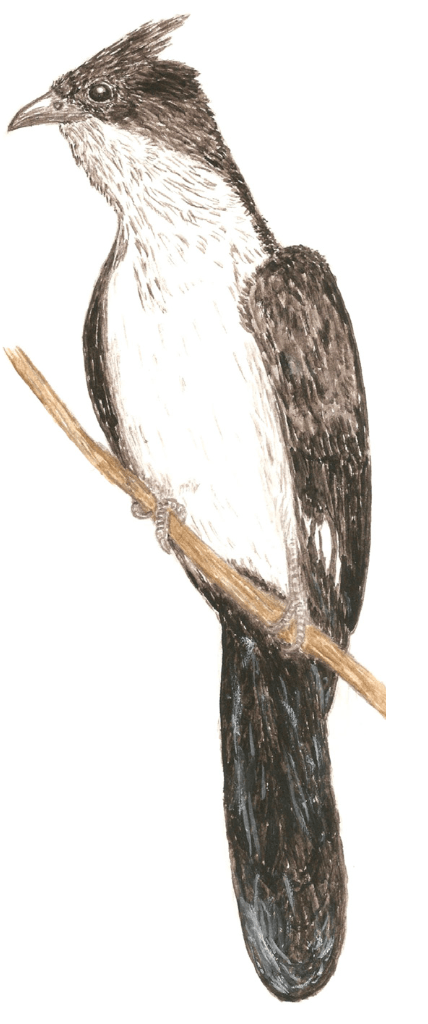
The Levaillant’s Cuckoo Clamator levaillantii and similar Jacobin Cuckoo Clamator jacobinus (pictured) are relatively common migrants to southern Africa, where they are active brood parasites from October to May, being particularly noisy at this time, uttering a loud and striking call. As their arrival coincides with the beginning of the wet season many local people believe that these calls serve to summon the rainfall, and indeed the Ndebele and Kalanga believe that no rain will arrive should one of these birds be killed. In addition, the presence of these cuckoos is regarded as particularly significant as it is thought that they may only drink rainwater that has collected in tree hollows, or from water droplets on leaves.

The Red-chested Cuckoo Cuculus solitarius is normally present from September to February. This bird is seldom seen, but is generally recognised by its plaintive three-syllable ‘Piet my vrou’ call, which may persist throughout the night. It is widely believed that this call heralds the rain and signals that ploughing of the fields should commence in preparation for planting.

The related Senegal Coucal Centropus senegalensis is a resident breeding species that nests during the rainy season, when are also particularly vocal, producing loud ‘bubbling’ duet calls. For this reason, they are also considered as important harbingers of rain in areas where they occur.

Local names for the Levaillant’s and Jacobin Cuckoo in Zimbabwe:

Haya, Hwaya, Dawa – Shona (all dialects)
iNkanku – Ndebele
Hunyi, Tatamagova – Shangaan
Klwa – baTonga/Nambya

Local names for the Red-chested Cuckoo in Zimbabwe:

Kukudza – Shona (all dialects)
iNkanku, umKubani – Ndebele
Tsheketani – Shangaan

Local names for the Senegal Coucal in Zimbabwe:

Murenda – Shona (all dialects)
uFukwe, umFuku, umGugwane – Ndebele

Information for this section was obtained only from original interviews with contributors. While the cuckoos and Senegal Coucal were found to be commonly recognised as important ‘rain birds’, a number of other taxa were also mentioned in this regard. These included the swallows and bee-eaters, many of which are migratory, arriving prior to the rains. I was however unable to corroborate this with more than three separate individuals and so omitted them. These birds will be discussed at a later stage.

Additional information on the Red-chested Cuckoo and Senegal Coucal for other parts of Africa is included below.

In a similar vein to both Zimbabwean and South African communities, the Marakwet people of western Kenya consider the Red-chested Cuckoo as a harbinger of precipitation for the upcoming growing season, and the call is described as ‘a voice that predicts rain’. Other Kenyan tribes share similar beliefs, the Kikuyu translating the call as ‘Where do I sow the seed?’

In West Africa, the Bassar of northern Togo associate the Senegal Coucal with laziness due to its skulking habits and relatively weak flight. Here the local name ‘natu’ likens it to a fool or idiot. However, in contrast, this species is considered an important totem in Benin, where their remains are often offered for sale in traditional markets.

Additional Reference:

Cocker, M & Tipling, D. (2013). Birds and People, Jonathan Cape, London, England.

For more information on the species mentioned here visit:

https://ebird.org/species/levcuc1

http://datazone.birdlife.org/species/factsheet/22683808

https://ebird.org/species/piecuc1?siteLanguage=en_AU

http://datazone.birdlife.org/species/factsheet/22683800

https://ebird.org/species/reccuc1

http://datazone.birdlife.org/species/factsheet/22683862

https://ebird.org/species/sencou1

http://datazone.birdlife.org/species/factsheet/22684284