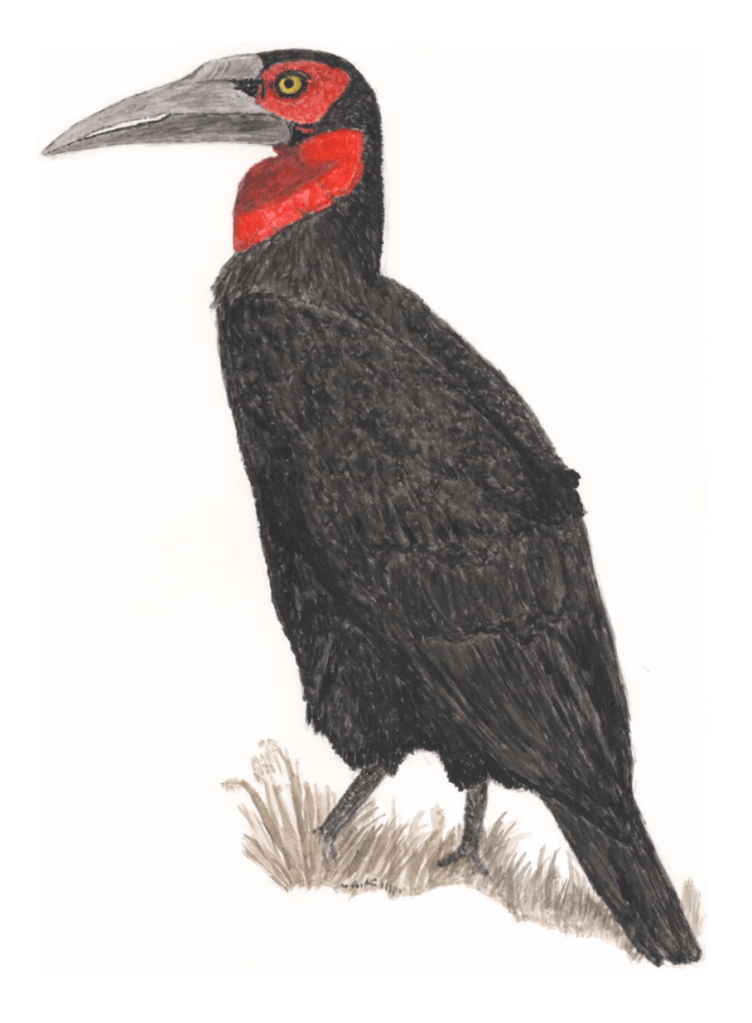
The Southern Ground-hornbill Bucorvus leadbeateri is a highly respected bird, particularly by the Ndebele people, who have retained many related beliefs of their Zulu forebears. Their habits, large size, and colouration make this a particularly striking species, recognised as a potent spirit medium. Indeed, elders interviewed in the Matobo Communual Lands were able to provide me with a great deal of information pertaining to them.
As their diet includes chameleons and snakes it is thought that this hornbill plays host to an ‘avenging’ spirit. It is also widely believed that they are extremely intelligent and that their preferred method of catching snakes is to entice them to strike at their outstretched wing, depleting their venom and allowing the hornbill to dispatch the reptile without fear of a poisonous bite.
Should a Ground-hornbill wander into, or fly over a village, this would almost certainly signal a bad omen, perhaps foretelling a calamity or death in the family. If one should ever land on the roof of a dwelling, the message would be so powerful that the whole village may be forced to relocate. The Ndebele also believe that if a hornbill is killed, the remaining group will mourn the birds death by continually calling near the perpetrators home, warning of the impending death of a family member in reprisal.
On the other hand, this species is recognised as an important messenger in relation to the procurement of rain by both the Ndebele and Shona. As their breeding season coincides with the onset of the first showers around October, and the frequency of their deep booming duet increases at this time, tribespeople strongly believe that these birds call for the first rains. It is also believed that Ground-hornbills are able to fly high out of the view of the average person and then return to earth uttering their call when they wish to pronounce a change in the weather.
There has been some further local variation in the interpretation of these low-pitched duets and two that were related to me can be roughly translated as follows:
Shona – When the male’s mother-in-law asks him to carry a heavy grindstone (guyo and duri) the other flock members leave him behind as he cannot fly with the heavy load on his back. Starting off, the female is said to complain to the stubborn male: ‘Ndipe, ndipe, ndikugwanzurire’ – ‘Give me, give me, so that I break it for you’, and in turn is answered by the male, ‘Handidi, handidi, ndiongwanzura ndonga’ – ‘I do not want, I do not want, I will break it on my own’. The male stubbornly remains behind and continues to complain – ‘Mm mm mm yamugo-go’ – ‘It’s too heavy, I cannot take off with this load on my back’.
Ndebele – The female calls: ‘Ngiyemuka, ngiyemuka, ngiyemuka, ngiyakwabakithi’ – ‘I am going, I am going, I am going, I am going back to my people.’ The male responds – ‘Hamba, hamba, kadusho’, saying ‘Go, go, go – I have long said so.’ This is said to be the sound of the foraging female complaining to her mate that she is returning to her own family, to which the male then responds.
During years of more serious drought, n’angas may, as a last resort, catch and drown a Ground-hornbill in a deep pool or river in a similar manner to the Bateleur Eagle. The death of the bird is said to awaken the sympathy of the sky, which mourns and weeps, bringing soft soaking rains. Another variation of this practice is to kill a bird and throw the carcass directly into a riverbed. As the flesh of these birds has a particularly strong odour, it is believed that the spirits of the river will be so ‘disgusted’ that they will send floodwaters to wash the remains away. Only traditional practitioners are generally permitted to carry out this practice, and even the feathers are not touched for fear of displeasing the spirits.
Elders also informed me that Ndebele traditional healers use the bones and feathers to make an infusion that is said to calm people of an agitated disposition, while powdered bones are rubbed into an incision in the shoulder to ward off lightning strike. Ground-hornbill remains are occasionally found in traditional markets for such purposes, however should a bird be killed for any reason, the spirits should be appeased by the slaughter of valuable livestock. The droppings are however said to represent good fortune and may be freely collected.
Local names for the Southern Ground-hornbill in Zimbabwe:
Dendera, Gahamadze, Riti – Shona (all dialects)
iNsingizi – Ndebele
iMuntuntule, Hundundule – Kalanga
LeHututu – Sotho
Dandila – Venda
Randaloa, Rhandzala – Shangaan
Momba – baTonga/Nambya
Information for this section was collected only from original interviews with contributors.
Broadly similar beliefs, taboos and practices to those mentioned are shared widely across eastern South Africa, where these birds are also associated with procurement of rainfall as well as being considered as harbingers of ill omen, particularly if harmed. Such consequences may include disease among cattle herds or household misfortune. Ground-hornbill body parts (or concoctions comprising thereof) are also widely used by traditional practitioners to enhance powers of prediction, procure rainfall, or prevent lightning damage.
The heads of Northern Ground-hornbills Bucorvus abyssinicus are also used for similar purposes in West Africa, while in Ethiopia the tail feathers of this species are worn as insignia of male courage and placed on the gravesite of distinguished individuals.
Additional Reference:
Cocker, M & Tipling, D. (2013). Birds and People, Jonathan Cape, London, England.
For more information on the species mentioned here visit:
https://ebird.org/species/soghor1/L915651
http://datazone.birdlife.org/species/factsheet/22682638
 Birdlore