The Greater Honeyguide in Zimbabwean Folklore

The Greater Honeyguide Indicator indicator is well respected in Zimbabwean folklore and I found it familiar to most people interviewed.

This species regularly attracts people (and possibly honey badgers) to beehives by uttering an excited chattering call, which can be likened to that of an excited squirrel. By following this bird one may be led to a hive full of honey. As the bird feeds largely on bee larvae and beeswax, but has no physical means of acquiring these, it must rely on such a symbiotic relationship to access honeycombs. Surrounding this is the ubiquitous belief that ‘fair play’ must be observed and that bad luck will befall a person who is guided to a hive, but fails to leave a portion of the spoils for the bird. It is also believed by some that if one chooses to follow a honeyguide, it is a ‘game of chance’ as the bird may lead a person to honey, or conversely to a dangerous animal such as a snake or lion. A variation on this belief, related to me by people of both Manyika and Shangaan origin, is that the bird could possibly also lead one to the locality of a human corpse.

Local names for the Greater Honeyguide in Zimbabwe:

Shezhu, Mukaranga, Tsoro, Tsare – Shona (All dialects)
iNsedlu, iMlezu – Ndebele/Kalanga
Tshetlo – Venda/Sotho
Hlalala – Shangaan
Nsolo – baTonga
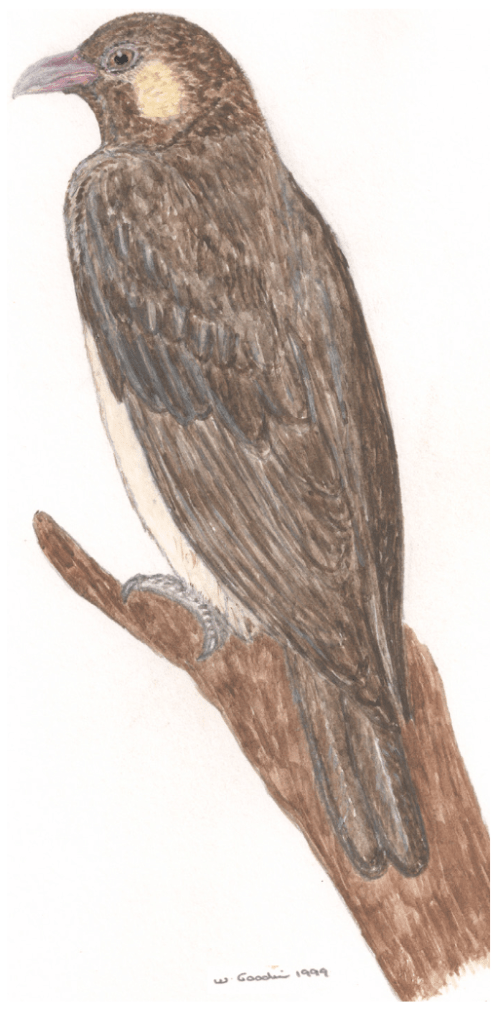
Information for this section was obtained from interviews with contributors as well as various other popular sources.

Similar beliefs surrounding the Greater Honeyguide are shared across Southern and East Africa.

Additional Reference:

Cocker, M & Tipling, D. (2013). Birds and People, Jonathan Cape, London, England.

For more information on this species visit:

https://ebird.org/species/grehon2

http://datazone.birdlife.org/species/factsheet/22680616

Hornbills (Bucerotidae) in Zimbabwean Folklore

The Southern Yellow-billed Hornbill Tockus leucomelas (pictured top) and the similar Red-billed Hornbill Tockus erythrorhynchus (rufirostris) are common residents of bushveld areas. During the summer breeding season, local people often collect and eat females and chicks trapped within their nest holes, which the birds seal using mud and faeces. As people have observed that the female and chicks are totally reliant upon the male for food provision during much of this time, these birds are often associated with marital fidelity in local tradition. I was also able to corroborate a belief of the Ndau and Shangaan that, as these hornbills appear to have weak flight, they are at the mercy of the wind, which determines the direction that they must follow.

The Trumpeter Hornbill Bycanistes bucinator (pictured bottom) bears the black and white plumage and red facial skin, associated with the spirits, and as such has become another subject of local superstitious belief. This species is largely restricted to wetter forest, woodlands and riverine areas where it feeds on fruit and invertebrates. Their loud calls vary from ‘wails’ and ‘caterwauls’ to ‘screams’ and ‘brays’, leading a number of Karanga, Korekore and Nambya people to believe that this species is a powerful messenger, often foretelling the outcome of a long journey. One particular call is translated as ‘Dzoka, dzoka’ meaning ‘come back, come back’, warning would-be travellers to postpone their journey. If the bird calls vigorously or persistently and makes short flights ahead of one’s path, it is thought to indicate danger ahead, while if the bird calls only occasionally during the trip, then all is expected to be well.

Local names for the Southern Yellow-billed and Red-billed Hornbill in Zimbabwe:

Hoto, Muthlawe – Shona (all dialects)
uKoro – Ndebele
Ngoto – Sotho
Kgoropo – Venda
Korho – Shangaan
Bangwa – baTonga

Local names for the Trumpeter Hornbill in Zimbabwe:

Gakamira, Gangambudzi – Shona (all dialects)
iFlakaka – Nambya
Hakamira – Shangaan
Pongopongo – baTonga

Information for this section was obtained only from interviews with contributors.

The Marakwet people of Kenya believe that the increased calling of the Red-billed Hornbill during the summer breeding season heralds the coming of the rains.

Hornbills of various species are considered as birds of great power in West Africa, where their body parts are widely traded for bushmeat or use in concoctions that provide perceived protection against witchcraft, increase work or business success, or for other physico-medicinal purposes.

Additional Reference:

Cocker, M & Tipling, D. (2013). Birds and People, Jonathan Cape, London, England.

For more information on the species mentioned here visit:

https://ebird.org/species/sybhor1?siteLanguage=en_AU

http://datazone.birdlife.org/species/factsheet/22682384

https://birdsoftheworld.org/bow/species/srbhor1/cur/introduction

https://ebird.org/species/rebhor1?siteLanguage=en_AU

http://datazone.birdlife.org/species/factsheet/22725930

https://ebird.org/species/truhor1

http://datazone.birdlife.org/species/factsheet/trumpeter-hornbill-bycanistes-bucinator